Bulgarian Split Squat: The Ultimate Guide
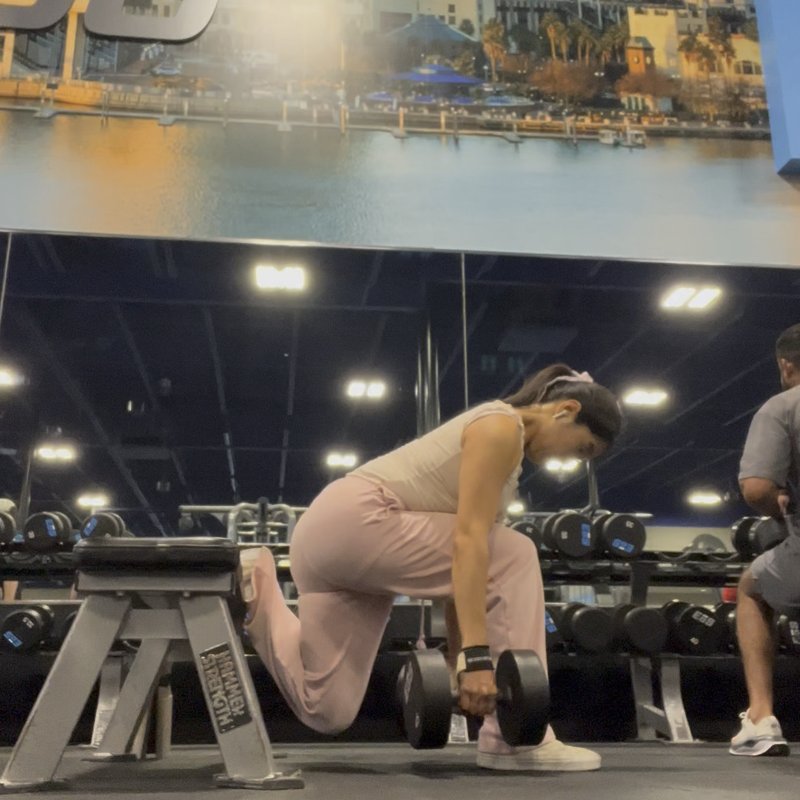
The Bulgarian Split Squat is a challenging unilateral lower body exercise that targets the quadriceps, glutes, and hamstrings while improving balance, correcting muscle imbalances, and enhancing functional strength.
By the Gravitus Team
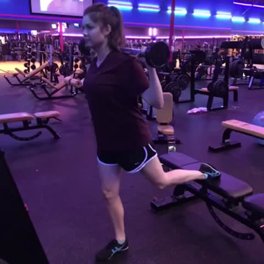
Quick Facts
Unilateral leg development and balance improvement
Glutes, Hamstrings, Quadriceps
Abdominals, Calves, Hip Adductors, Hip Flexors
bodyweight, dumbbells (optional), flat bench (optional)
Intermediate
Strength
In This Guide
Track Your Bulgarian Split Squat Progress
Log sets, track PRs, and see your strength gains over time.


Benefits of Bulgarian Split Squats
The Bulgarian split squat offers several distinct advantages compared to many other lower body exercises.
Proper Form & Technique
Muscles Worked
Common Mistakes and How to Fix Them
Bulgarian Split Squat Variations
How to Progress
The Bulgarian split squat can be systematically progressed from beginner to advanced levels through various methods.
Beginner Level
Start with bodyweight only, focusing on balance and proper form. Begin with 2-3 sets of 8-10 repetitions per leg. Place your hands on fixed objects for balance assistance if needed initially. Use a lower bench or step to reduce the challenge until balance improves. Focus on controlled eccentric (lowering) phases of 3-4 seconds to build stability and strength. Once you can perform 3 sets of 12-15 perfect repetitions with bodyweight, you're ready to add external resistance.
Intermediate Level
Progress to holding light dumbbells (5-15 pounds per hand) at your sides. Gradually increase weight as form and strength improve. Implement different rep ranges (8-12 for hypertrophy, 4-6 for strength) across multiple working sets. Incorporate techniques like pause reps (2-3 second hold at the bottom) or 1½ reps (performing a half rep at the bottom before the full rep). Experiment with foot positions to shift emphasis between quadriceps and glutes. Aim for 3-4 sets of 8-12 repetitions with good form before increasing weight.
Advanced Level
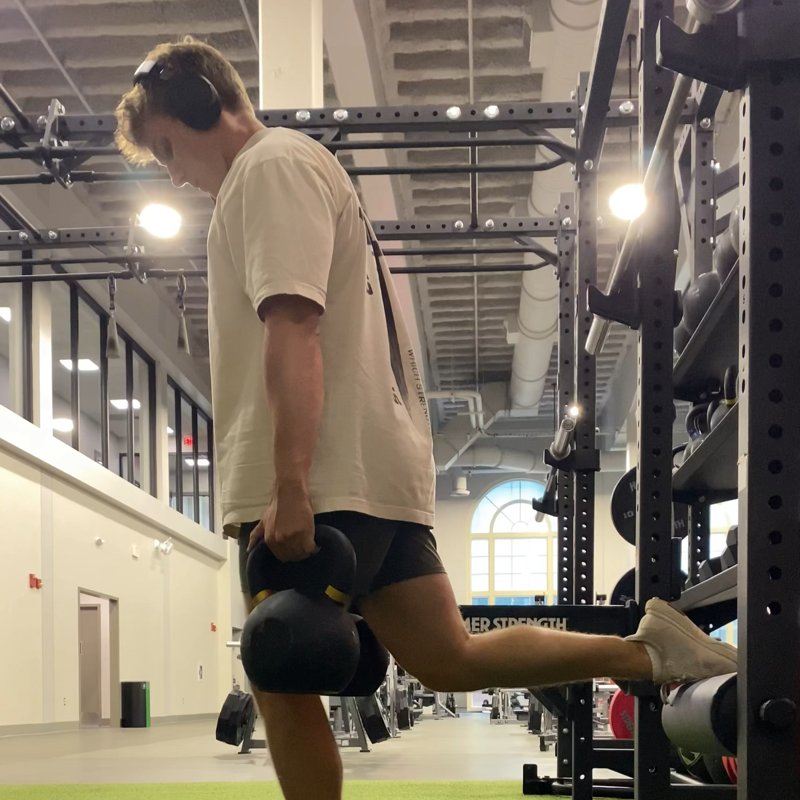
Use heavier dumbbells, kettlebells, or a barbell across your back for substantial loading. Add advanced intensity techniques like drop sets, tempo manipulation, or limited rest between legs. Incorporate deficit variations by elevating the front foot to increase range of motion. Experiment with unstable surfaces for the front foot to increase proprioceptive demands. Consider weighted vest addition for more even weight distribution. Implement more sophisticated programming approaches like wave loading or cluster sets. Some advanced lifters may progress to using 70+ pounds of external resistance for lower repetition work.
Frequently Asked Questions
Video Demonstrations
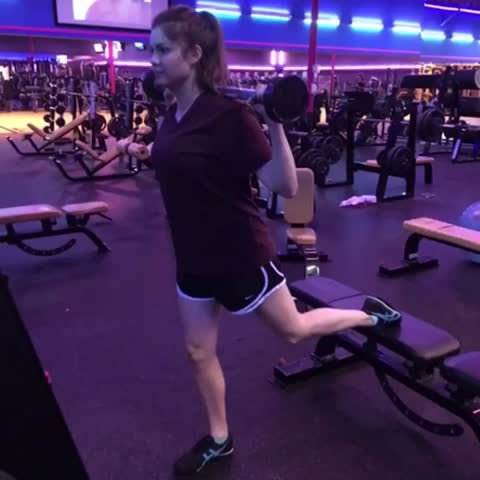
Log in to watch video demonstrations
Login to Watch3 video demonstrations available
Find more video demonstrations in the Gravitus app
Tips from the Community
-

The closer you have your front foot to the bench the more this exercise works the quads. The further away the front foot is from the bench the more it works the posterior chain and hip flexors.
-

Drop a plate on the floor to mark your ideal foot position.
-

Make sure your knee doesn't move past toe on descend.
-
Stay tight and strong throughout the entire movement.
-
Focus on pushing through your heel, to protect your knees.
Ready to get serious about your Bulgarian Split Squat?
Download Gravitus to track your sets, monitor PRs, and follow structured programs built around exercises like this.
Related Exercises
Helpful Resources
One Rep Max Calculator
Find your one rep max for any exercise without maximal testing. Essential for developing effective strength training programs.
Calculate 1RMWorkout Programs
Follow structured workout programs created by fitness professionals to maximize your strength and muscle gains.
View Programs